MASTERING THE REAL ESTATE MARKET: YOUR GUIDE TO THE QUADRANTS CYCLE
Many of us tend to think of the real estate market as one big, unchanging thing. But in reality, it’s a super complex, always-moving system, always shifting and changing. Smart investors, clever developers, and sharp analysts all know that this market never just goes in a straight line. Instead, it moves through clear, recognizable stages, ebbing and flowing like the tide. To truly get a handle on these movements, one of the best tools we have is the Real Estate Market Quadrants Cycle.
This isn’t just another simple boom-and-bust story. This clever model offers a really detailed look at how the market actually works, giving pros the power to make much smarter, more strategic choices. So, join us as we dive deep into what this market quadrants cycle is all about, why it’s absolutely essential for anyone hoping to succeed in real estate, and most importantly, how you can skillfully navigate its different phases.
TWO SIDES OF THE REAL ESTATE COIN: SPACE AND CAPITAL
Before we jump into the quadrants themselves, it’s really important to understand the two fundamental markets that power real estate performance. Think of them as two sides of the same coin.
First up, we have the Space Market, sometimes called the User Market. This is where the rubber meets the road, focusing on how much physical space people want and how much is available. Think about it: this is where tenants sign leases and everyday users actually occupy buildings. To get a pulse on this market, we look at things like how many empty properties there are (vacancy rates), how quickly space is being filled (absorption rates), what rents are like, and how much new construction is popping up. The overall health of this market is deeply connected to local economic growth, shifts in population, and general business activity.
Then there’s the Capital Market, or the Asset Market. Here, we see real estate primarily as an investment, valued for its potential to bring in returns for those who put their money into it. This is the arena where properties are actively bought and sold. What drives it? Things like capitalization rates (or cap rates), interest rates, how easy it is to get loans or equity, how investors are feeling (sentiment), and even bigger global economic trends all play a huge part.
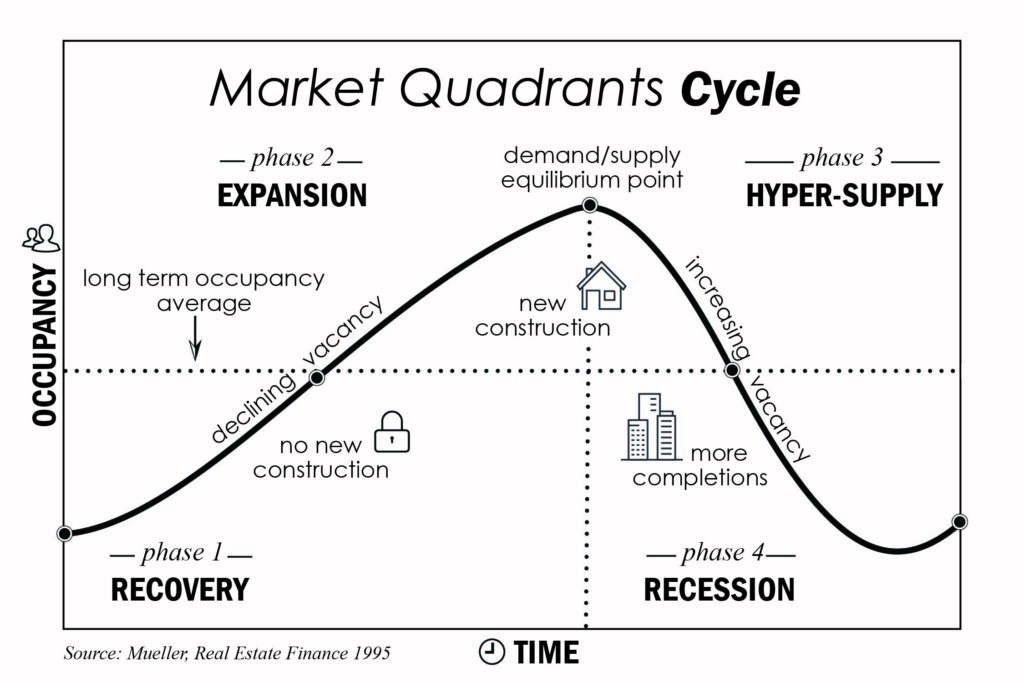
The entire Real Estate Market Quadrants Cycle really comes alive from the constant interaction – and often, the slightly out-of-sync movements – of these two crucial markets. While we frequently talk about it as four separate phases or ‘quadrants,’ it’s actually a never-ending cycle. Each phase, you see, has its own unique set of dynamics happening in both the space and capital markets simultaneously.
EXPLORING THE MARKET’S FOUR PRIMARY PHASES
Typically, this market cycle unfolds through four main quadrants. Each one has its own distinct personality, requiring you to think about strategies in different ways. It’s super important to remember, though, that this cycle almost never runs perfectly smoothly or predictably. Plus, various local markets or specific kinds of properties might even move through these phases at their own unique speeds.
1. RECOVERY: THE MARKET FINDS ITS FOOTING AGAIN
The Recovery phase is essentially the start of the market’s rebound after a tough recession or downturn. In the Space Market, you’ll notice vacancy rates are still high, but they’re either holding steady or just beginning their slow, downward creep. Rents have hit rock bottom and might show only the tiniest hint of growth. New construction? Practically nowhere to be found, largely thanks to past oversupply and a general lack of demand. However, the good news is that absorption – meaning the net amount of space being occupied – starts to turn positive, even if it’s a gradual process. Over in the Capital Market, cap rates tend to be high, which tells us that property values are still low compared to their income. But watch out, because these rates are beginning to stabilize or even compress slightly as investor confidence slowly, cautiously returns. This is when the early birds, often those contrarian or value-add investors, start sniffing around, looking for distressed properties or assets that are cheaper than building new. While cash might still feel a bit tight, lending conditions are definitely starting to get better.
For long-term investors, this is often seen as a golden opportunity to scoop up undervalued assets, especially those that could use a little TLC or a fresh new purpose. Sure, the risks are certainly higher during this stage. But on the flip side, the potential for a really big jump in property value as the market gets better is equally significant.
2. EXPANSION: FULL STEAM AHEAD WITH ROBUST GROWTH
The Expansion quadrant is all about powerful, sustained growth, hitting both the space and capital markets with full force. In the Space Market, you’ll see vacancy rates plummeting fast, which naturally drives strong rent increases across nearly all property types. The demand for space is incredibly robust, powered by a booming economy and plenty of new jobs being created. Naturally, new construction really starts to ramp up, as developers rush to meet the demand, responding to higher rents and shrinking vacancies. Absorption rates are at their peak during this time. Looking at the Capital Market, cap rates keep on compressing, meaning property values are soaring much faster compared to their income. This draws in all sorts of investors, from big institutions to international funds. Property values shoot up rapidly, and there’s a huge volume of transactions happening. Getting financing is easy, often with really attractive terms. Investor confidence is through the roof, which, let’s be honest, sometimes spills over into a bit of speculative excitement.
3. HYPER-SUPPLY: TOO MUCH OF A GOOD THING
The Hyper-supply quadrant is a clear signal that things are starting to change. That earlier enthusiasm from the expansion phase often leads to too much building, and suddenly, the market begins to feel saturated. In the Space Market, all that new construction that kicked off during the boom now starts hitting the market, often creating way more supply than current demand can handle. So, vacancy rates begin to creep up because the market is just absorbing this new inventory at a much slower pace. Rent growth slows right down, flattens out, or you might even see small dips in specific areas or for certain property types. Naturally, absorption rates also take a dip. Over in the Capital Market, cap rates either hold steady or begin to decompress a little, which hints at property values either flattening or starting a gentle decline. Investor excitement starts to fade, replaced by a healthy dose of caution. You might notice fewer transactions happening, as buyers and sellers struggle to agree on a fair price. Plus, lenders usually start getting a bit stricter, and you might need more equity to get a deal done.
This phase definitely calls for a much more careful approach. Developers might decide to hit pause on new projects or really focus their energy on pre-leasing existing spaces. If you already own properties, your main focus should be on keeping your current tenants happy and managing your properties super efficiently. This is also a smart time to take a hard look at your investment portfolio and maybe sell off any assets that aren’t performing well, ideally before the market fully heads south.
4. RECESSION: NAVIGATING THE DOWNTURN
The Recession quadrant is all about decline, often sparked by wider economic troubles, a credit crunch, or just simply way too much supply. In the Space Market, vacancy rates shoot up dramatically because of negative absorption – meaning more space is being emptied out than is being filled. Rents fall quite a bit, and it becomes pretty common for landlords to offer various concessions to attract tenants. New construction mostly grinds to a complete stop, with tons of projects getting pushed back or even cancelled altogether. On the Capital Market side, cap rates decompress significantly, which tells us that property values are definitely shrinking. Investor demand is super low, and cash flow (liquidity) just dries right up. Getting financing becomes a real struggle, and you’ll start seeing a lot more distressed sales happening. Investor sentiment hits rock bottom, and everyone’s main focus shifts to simply protecting their money.
While this is undoubtedly a tough time, it can actually open up some amazing opportunities for investors who are well-funded and patient. The main goal here shifts to keeping your capital safe, running your existing properties as efficiently as possible, and actively looking for those distressed opportunities. Making smart acquisitions during this phase, right when the market hits its lowest point, can really pay off with huge returns once the recovery kicks in.
WHY THIS CYCLE IS YOUR SECRET WEAPON IN REAL ESTATE
For anyone serious about real estate, truly understanding the market quadrants cycle isn’t just a textbook exercise; it’s an absolute game-changer. It offers a ton of key benefits that can make or break your success. First off, it helps you optimize your investment timing, giving you clear insights on when it’s best to buy, hold, or sell, ultimately boosting your profits and slashing your risks. This knowledge also guides you in making informed asset selections, as certain property types, like apartments during recovery or industrial spaces during expansion, often perform better in different stages. Developers can make much smarter strategic development decisions, timing new projects perfectly with rising demand and steering clear of overbuilding during the hyper-supply phase. It’s also vital for effective financing and risk management, since your understanding of the cycle directly impacts lending standards, interest rates, and overall market risk, leading to better decisions about your capital structure. You’ll be able to perform more accurate valuations and forecasting, as the cycle provides essential context for today’s property values and helps you predict future rental rates and how much your capital might appreciate. Finally, it enables proactive portfolio management, letting you adjust your strategies – perhaps focusing on tenant retention during hyper-supply or hunting for distressed assets during a recession – to protect and grow your portfolio’s value.
YOUR ESSENTIAL TOOLKIT: KEY INDICATORS TO WATCH
To effectively navigate this cycle, you’ll need to keep a close eye on a variety of important data points. For the Space Market, you should always track vacancy rates, which tell you the percentage of empty space, and absorption rates, showing the net change in occupied space over a specific period. Don’t forget rental rates – the average rent per square foot – and how much they’re growing. Also, pay attention to the construction pipeline and new starts, which signal how much fresh supply is on its way. Crucially, employment growth and population changes are big drivers of demand for space, so keep them on your radar too.
When it comes to the Capital Market, your indicators include capitalization rates, or cap rates, which are essentially net operating income divided by the property’s value. You’ll also want to monitor interest rates and lending standards, as these reveal the cost and accessibility of debt. Track transaction volume and pricing to see how much activity there is and what sales prices are doing. Looking at public REIT performance can also give you a good sense of investor sentiment in the wider market. Beyond that, keep an eye on broader economic health through GDP growth and inflation figures, and definitely check out investor sentiment surveys to gauge confidence and expectations.
THE REAL WORLD: NUANCES AND OBSTACLES
While the market quadrants cycle is an incredibly powerful tool, it’s not a perfect crystal ball, and you need to be aware of its nuances. Remember that market segmentation is real: the cycle can look very different depending on the property type, like office versus residential, or by geographic region, such as Dallas compared to New York, and even within specific submarkets. Then there are those external shocks, often called ‘Black Swans’ – think unforeseen events like pandemics, natural disasters, or major geopolitical crises – which can suddenly throw market phases off course or speed them up unexpectedly. Government policy also plays a huge role; fiscal and monetary decisions, such as changes in interest rates or zoning reforms, can heavily sway market dynamics. Finally, be mindful of data lag: real estate information often comes with a delay, meaning that the decisions you’re making today are based on data that’s already a bit in the past.
YOUR PATH TO REAL ESTATE MASTERY
Ultimately, the Real Estate Market Quadrants Cycle gives us an incredibly valuable roadmap for truly understanding the complex, intertwined relationship between the space and capital markets. By consistently keeping tabs on key indicators and clearly recognizing the unique traits of each phase – Recovery, Expansion, Hyper-supply, and Recession – real estate pros can stop just reacting to market changes. In an industry where cycles are simply a fact of life, grabbing hold of this powerful analytical tool empowers investors, developers, and brokers alike to foresee shifts, lessen potential risks, and grab hold of fantastic opportunities. All of this, of course, leads to real estate ventures that are much stronger and far more profitable. Remember, in this ever-changing industry, ongoing learning and careful market observation are the true secrets to lasting success.